Dish Quality During Service: The IUOAMC Reference for First-Pass Conformity and Variation
IUOAMC-SQRF · Version 1.0
Download article PDFIn this article
 Scan to verify the article
The best plate is not the whole service
A station may produce an excellent plate in a quiet trial and struggle when demand or personnel change. IUOAMC–SQRF 1.0 is an original workflow connecting specification, service observation, conformity and corrective action. Its question is not whether success is possible once, but under which recorded conditions it can be sustained.
Define conformity beforehand
Tie the specification to a recipe version: portion mass, reference appearance, intended texture, component arrangement and relevant service conditions. State what is instrument-measured, what needs a sensory description and who decides. Do not borrow numerical tolerances simply because another kitchen uses them.
| Dimension | Check | What it cannot establish alone |
|---|---|---|
| Quantity | Net mass, stated unit and tare | Correct mass does not establish correct flavour |
| Execution | Defined technical attribute | Appearance does not establish texture |
| Service | Recorded timing, measurement point and load | Short time does not establish safety |
| Safety | Hazard-appropriate controls and measurements | Tasting does not establish microbiological safety |
Separate measurement from product variation
NIST’s measurement handbook explains that changing conditions over time and handling can contribute variation. In a kitchen, review units, scale use, tare and weighing stage before attributing every difference to a cook. This is an educational application of measurement reasoning, not a complete calibration study or statistical proof of process stability.
Observe under declared operating conditions
Plan observations across service opening, peak demand and handover as appropriate to the operation. Record uninspected output; selected plates are not the entire production. Deliberately difficult cases form a challenge sample, not necessarily a representative sample. Keep acceptance criteria fixed for the period, or separate results by specification version.
A worked example that preserves failures
Hypothetically, 30 portions are started and all 30 receive a first inspection. Twenty-six conform immediately, three conform after rework and one is discarded.
| Indicator | Calculation | Interpretation |
|---|---|---|
| First-pass conformity | 26 / 30 × 100 = 86.7% | Execution before rework |
| Conforming after correction | 26 + 3 = 29 | Final total does not erase initial failure |
| Rework | 3 / 30 × 100 = 10.0% | Additional operating demand |
| Discard | 1 / 30 × 100 = 3.3% | Remains within the started-portion denominator |
Calling 29/30, or 96.7%, first-pass conformity hides the correction step. Do not count a reworked portion twice in the denominator. These are teaching counts, not universal quality targets or process-capability estimates.
Write a deviation record that can be tested
| Field | Proposed record |
|---|---|
| Specification | Dish code, recipe version and acceptance rule |
| Context | Time, load, station and equipment |
| Outcome | First inspection, rework and final disposition |
| Explanation | Suspected cause distinguished from established cause |
| Verification | Specific correction, responsible person and recheck |
If texture deteriorates at peak demand, investigate waiting, load and operation sequence before rewriting the whole recipe. Where practicable, change a defined factor and document it. If several factors change together, improvement cannot automatically be attributed to just one.
Use decision gates, not only averages
A safety concern stops tasting and service under the establishment’s procedure and is escalated to the responsible specialist. A quality deviation receives a defined disposition: conforming, correctable before service or rejected. A satisfactory average does not excuse a critical failure. “Staff reminded” is not closure without a subsequent check.
Close the loop with cost
Retain the first-inspection result after correction. Link rework to time, materials and actual yield. Use the standard-recipe reference to explain the cost effect of discarded portions, and the sensory reference to make descriptions interpretable. Traceable decisions strengthen service control; deleting difficult cases merely improves the reported number.
Supporting sources and scope
Sources accessed on 2 November 2026. The workflows, tables and examples are original IUOAMC editorial material; examples are hypothetical, not reported experimental findings.
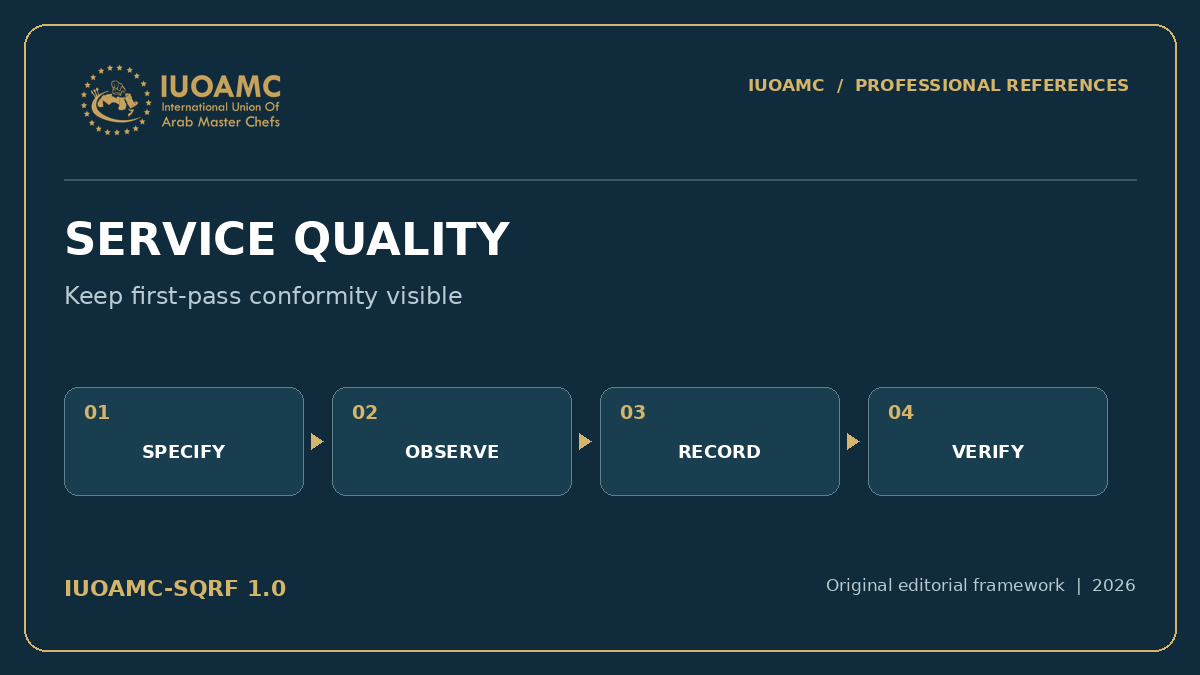
IUOAMC · Original editorial graphic Source or licence URL
Cite this reference
Version 1.0
Published update history
- · Version 1.0
First edition: operational workflow, tables, teaching examples and supporting sources in three languages.