Sensory Evaluation of Dishes: The IUOAMC Reference for Observation, Evidence and Judging Decisions
IUOAMC-SJER · Version 1.0
Download article PDFIn this article
 Scan to verify the article
A decision needs a shared meaning
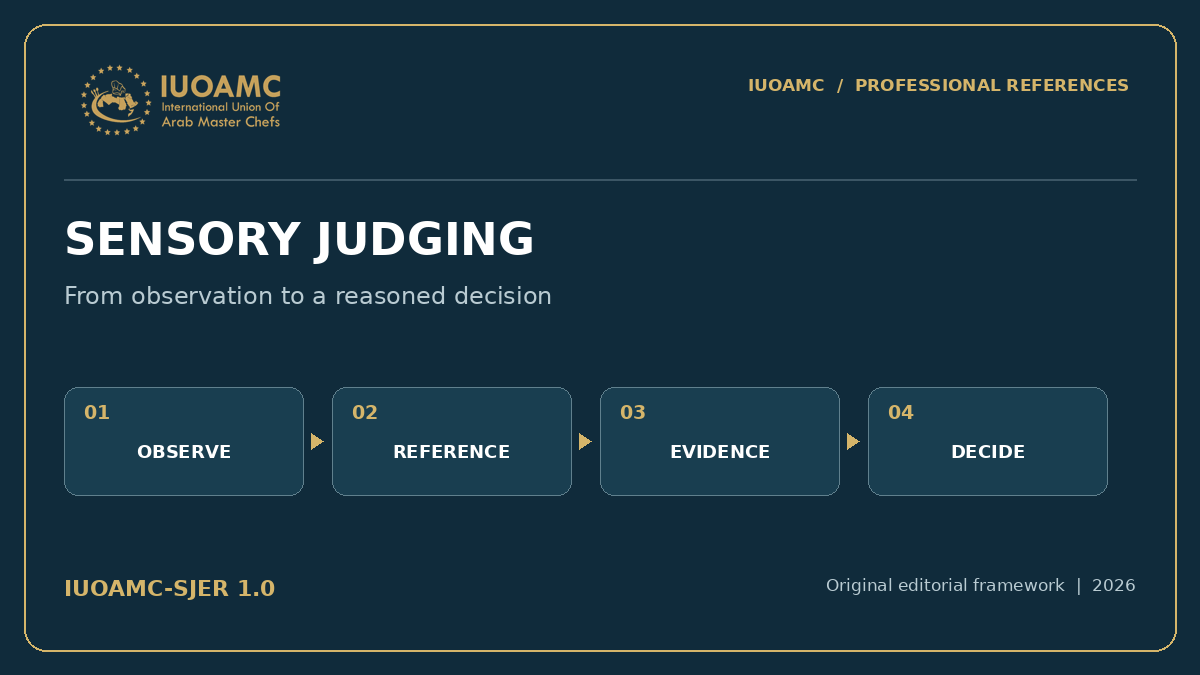
Two judges may call a dish balanced while referring to different things: acidity against fat, or the relationship between crisp and soft elements. A useful judging sheet therefore begins with a defined question and vocabulary. IUOAMC–SJER 1.0 proposes an original working sequence: observation, reference, evidence and decision. It structures the explanation of a judgment; it is not, by itself, a validated statistical test.
Choose the question before the score
The public scope of ISO 6658 distinguishes objective sensory examination from acceptance or preference testing. This distinction helps prevent a personal preference from being presented as evidence of technical execution. This guide does not reproduce the paid standard or claim full compliance with its procedures.
| Question | Evidence collected | Limit |
|---|---|---|
| What is perceived? | A named attribute and its intensity | Description alone does not establish preference |
| Does it meet the specification? | Comparison with a declared reference | The decision applies to that specification |
| Do consumers like it? | Responses from a defined consumer group | Do not generalize to an unstudied population |
Keep the four links connected
| Link | Record | Review question |
|---|---|---|
| Observation | Attribute, location and timing | What exactly was observed? |
| Reference | Specification or described teaching example | What was the comparison? |
| Evidence | Sample identity, conditions and independent note | Can the comparison be interpreted? |
| Decision | Rating, reason and boundary | Does the conclusion exceed the evidence? |
“The outer layer no longer fractured as specified when cut after arrival” is more useful than “poor texture”. This hypothetical observation still needs a timing record and a reference. A photograph cannot establish it, and its cause should not be assumed.
Control the session, preserve independence
Record the sample code and recipe version, presentation sequence, preparation-to-assessment interval and relevant room conditions. Collect individual notes before discussion. Distinguish agreement from unresolved differences. Coding samples and limiting brand or person information may reduce irrelevant cues when identity is not part of the legitimate question. An outlying view should not be deleted simply because it differs from the average.
Worked example: declared weighting
For teaching only, suppose four criteria have weights totaling 100 and an administrative scale from 0 to 4. Define criterion-specific anchors before assessment. Arithmetic does not turn ordinal categories into equally spaced physical measurements.
| Criterion | Weight | Rating / 4 | Contribution |
|---|---|---|---|
| Specified flavour | 30 | 3 | 22.50 |
| Texture | 30 | 2 | 15.00 |
| Technical execution | 25 | 3 | 18.75 |
| Presentation | 15 | 4 | 15.00 |
The result is 30×3÷4 + 30×2÷4 + 25×3÷4 + 15×4÷4 = 71.25/100. This is not a universal pass threshold. For an unassessable criterion, use a rule declared beforehand; do not automatically enter zero or redistribute weight after seeing the outcome.
Investigate disagreement before resolving it
Check whether judges assessed equivalent samples at the same stage and against the same reference. Then review attribute definitions, perceived intensity and scale use. A vague anchor or a changed serving condition may explain divergence; legitimate professional disagreement may remain. Record the explanation, verification action and decision-maker. Retasting alone is not statistical validation of panel accuracy, and consensus must not be invented.
Safety is outside compensatory scoring
IFST guidance emphasizes appropriate risk consideration in sensory work. Under this workflow, suspected unsafe samples or uncertain ingredient information stop tasting and trigger referral to the responsible specialist. Pleasant flavour does not demonstrate microbiological safety. Presentation points must never compensate for a safety concern.
A concise decision record
Keep session and sample identifiers, recipe version, assessment question, reference, serving conditions, independent observation, rating, explanation, dissent, corrective action and limits together. Link the record to the standard recipe and to service-repeatability evidence. The strongest plate on one occasion is not proof of consistent execution.
Supporting sources and scope
Sources accessed on 2 November 2026. The workflows, tables and examples are original IUOAMC editorial material; examples are hypothetical, not reported experimental findings.
IUOAMC · Original editorial graphic Source or licence URL
Cite this reference
Version 1.0
Published update history
- · Version 1.0
First edition: operational workflow, tables, teaching examples and supporting sources in three languages.