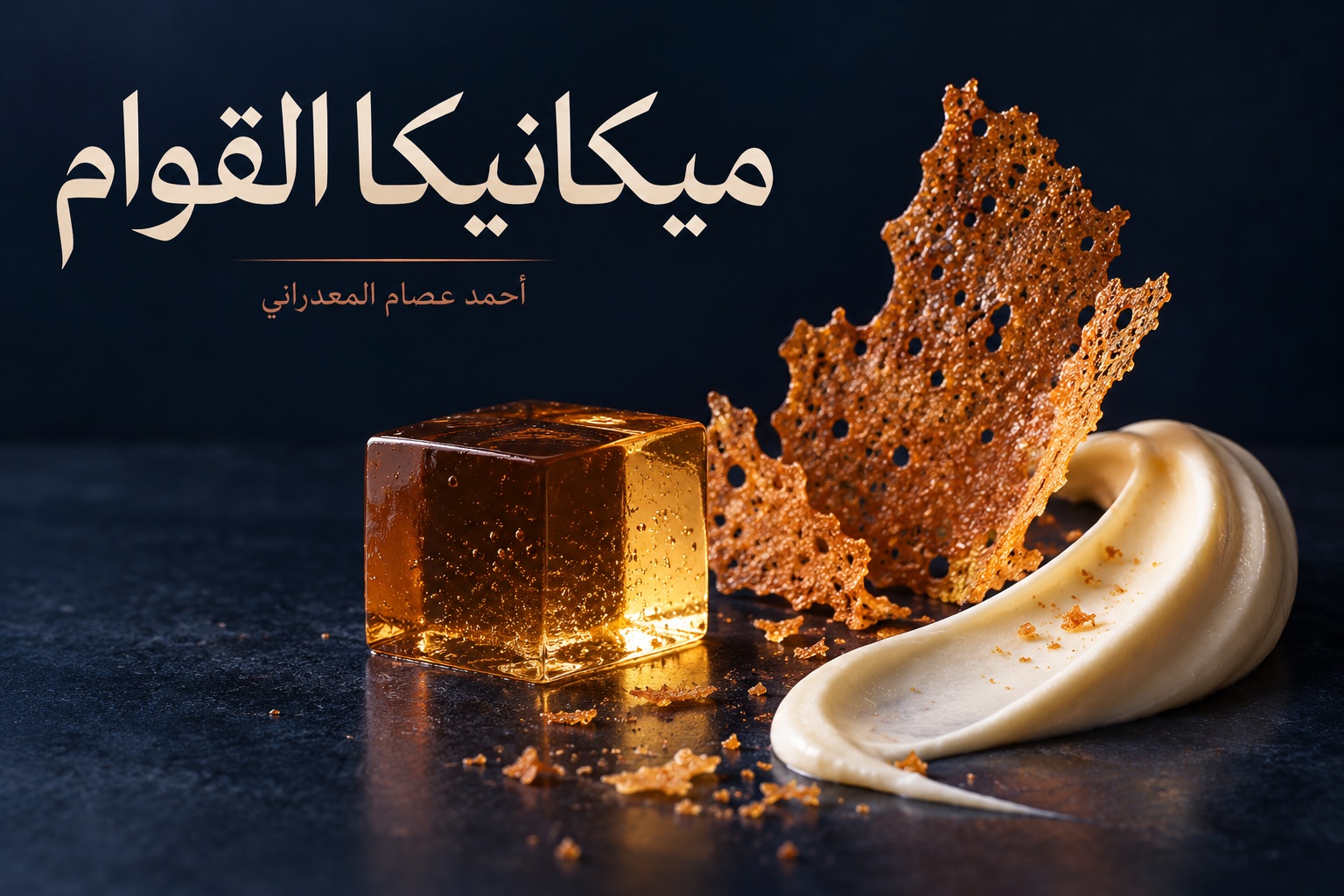
Texture Mechanics: Fracture, Viscosity and Cohesion During Chewing
Sensory Science and Judging Ethics — Ahmad Issam Maadarani’s Series
Download article PDFBy Ahmad Issam Maadarani
Ahmad Issam Maadarani ties texture descriptors to the action revealing them: pressure, fracture, movement or chewing. He proposes evaluating texture through function and trajectory while separating mechanical measurement from sensory reporting, making “soft,” “hard” and “creamy” more interpretable.
1. A descriptor needs an action
“Hard” is incomplete without specifying first bite, tongue pressure or chewing the interior. One element may require initial force and then fragment easily; another may start soft yet remain resistant. Record action, location and time alongside the descriptor. This avoids reducing texture to appearance or one movement and allows a closer reproduction of the original observation. A texture judgment should identify what the eater was doing when the property became apparent.
2. Structure and quality
An experiment on emulsion-filled gels investigated how droplet–matrix interactions affected large-deformation behaviour. It concerned model food materials and did not establish a universal culinary quality scale. [GEL07] The author uses this boundary to distinguish structure from superiority. Compression resistance describes a material under specified test conditions; it cannot establish culinary merit without an intended function and bite.
3. An action-to-description map
Link initial pressure to resistance, biting to fracture pattern, movement to spreading, chewing to persistent cohesion, and the finish to residual sensation. A hypothetical cohesive gel may carry sauce effectively on a spoon yet feel laborious alone. Preserve both observations because action and context differ. Initial brittleness may coexist with later cohesion, so retain stages before summarizing the whole experience.
4. A limited comparison
Prepare two familiar food versions differing in a known structural factor. Standardize size, storage time and serving temperature. Where equipment permits, measure fracture force or viscosity and retain method and sample dimensions. Assessors then describe the same action under standardized conditions. Investigate the relationship between number and description in these samples rather than assuming it. Repeat independent batches to distinguish formulation differences from one preparation’s particular behaviour.
5. Quality as trajectory suitability
The proposed criterion is support for an intended transition: clear fracture followed by comfortable fragmentation, or cohesion that carries components before breaking down to reveal them. These are design aims, not universal taste laws. A preference for greater resistance is not automatically an assessor error. Record task suitability and personal liking separately, including reasons the declared task itself might require reconsideration.
6. Measurement limits and record
Retain the changed factor, sample dimensions, temperature, measuring action, sensory descriptor, stage and suitability. Laboratory equipment does not reproduce every oral condition, and equal numbers do not prove identical experiences. The record may support shared discussion, but its usefulness requires repeatability and individual-difference data. Together with service robustness, this article distinguishes the product’s endurance before eating from its behaviour during eating.
Application worksheet
| Field | What to retain |
|---|---|
| Sample | Structural factor, dimensions and temperature |
| Action | Pressure, fracture or chewing and measuring method |
| Trajectory | Descriptor, stage and function |
The author’s analysis and proposals; examples are hypothetical and proposed procedures have not been tested here. No new experimental data are presented. Research-attributed claims remain within their source scope.
Related articles
References and source scope
- [GEL07]Sala, G., van Aken, G. A., Cohen Stuart, M. A., & van de Velde, F. (2007). Effect of droplet-matrix interactions on large deformation properties of emulsion-filled gels. Journal of Texture Studies, 38(4), 511–535. DOI: 10.1111/j.1745-4603.2007.00110.x.https://research.wur.nl/en/publications/effect-of-droplet-matrix-interactions-on-large-deformation-proper/
Model materials; not a universal quality scale.
Publication metadata and available abstracts were used; complete original texts were not fully reviewed for this edition.