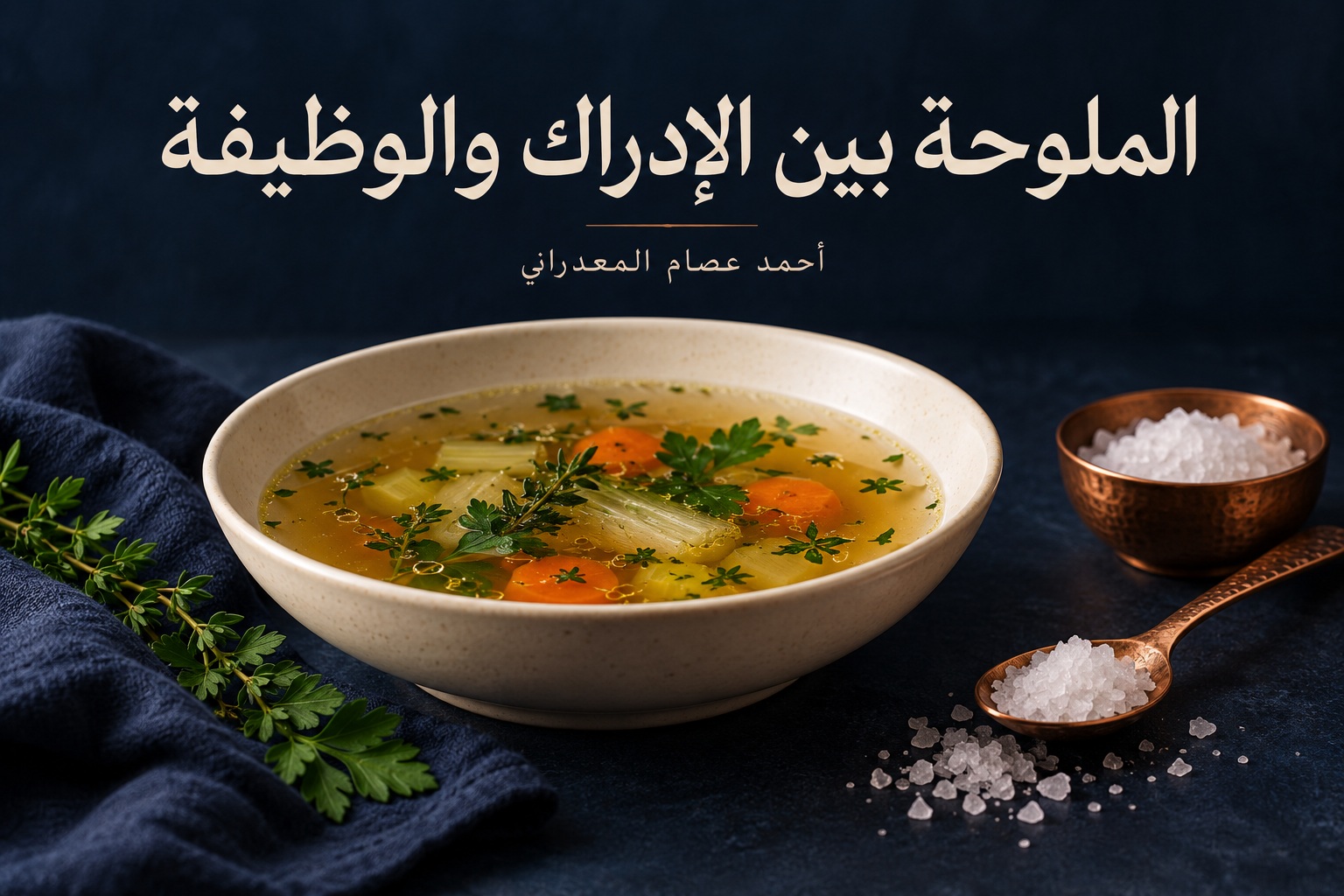
Saltiness Between Perception and Function: When Does Salt Support a Dish?
Sensory Science and Judging Ethics — Ahmad Issam Maadarani’s Series
Download article PDFBy Ahmad Issam Maadarani
Ahmad Issam Maadarani distinguishes salt quantity, perceived saltiness and suitability for a culinary task. He proposes a record linking dose, bite conditions and the timing of sensation. This analytical framework requires independent human testing before its performance can be claimed.
1. Three different questions
How much salt was added? How salty did the sample seem? Did that sensation support the intended dish? These are compositional, perceptual and evaluative questions. Agreement about dose need not imply agreement about perception, while agreement about perception need not imply agreement about quality. A useful report identifies its question explicitly. Knowing a recipe cannot substitute for tasting it, and individual preference cannot automatically define successful execution for everyone.
2. Evidence and transfer
A mouse experiment linked ENaC to sodium taste responses and salt attraction. It provides mechanistic animal evidence, rather than an ideal dose or judging score for human dishes. [SALT10] Culinary transfer requires testing the actual product and intended assessors. Naming a channel does not settle quality: a quality judgment also depends on the declared task, comparison and service conditions.
3. Saltiness within a bite
The proposed record describes onset, peak, finish and location across components. In a hypothetical example, a salty point on a crisp element could work in a bite containing sauce yet dominate when eaten alone. Record the bite composition before attributing the difference to dose. Assessors should describe effects on component clarity and continued eating instead of recording only “too much salt.” Timing is part of the observation, not proof of a physiological mechanism.
4. A three-version comparison
Divide one food base into three versions with weighed additions of food-grade salt within ordinary recipe levels. Record salt relative to final product mass, and standardize portion size, temperature and serving time. Code samples and counterbalance their order across assessors. Record saltiness intensity separately from task suitability. Repeat using a fresh preparation: multiple tastes from one pot are repeated observations, not independent production batches.
5. Decision and objection
Declare whether the task is ingredient clarity, brief contrast or a comfortable finish. A version may improve one aim while weakening another; report the trade-off instead of concealing it in a total score. Familiarity is a reasonable competing explanation. Record familiarity and liking separately, and inspect individual responses before recommending a formulation for a specific product category.
6. Limits and worksheet
This comparison measures neither daily sodium intake nor health superiority. A finding in soup does not automatically transfer to bread or dessert. The worksheet retains salt and product mass, bite composition, temperature, order, onset and finish ratings, and the reason for suitability. It becomes a research instrument only after actual data establish repeatability. Until then, its status is a proposed analytical framework with an explicit evidence boundary.
Application worksheet
| Field | What to retain |
|---|---|
| Dose | Salt mass and final product mass |
| Bite | Components, temperature and order |
| Judgment | Onset, finish and suitability |
The author’s analysis and proposals; examples are hypothetical and proposed procedures have not been tested here. No new experimental data are presented. Research-attributed claims remain within their source scope.
Related articles
References and source scope
- [SALT10]Chandrashekar, J., et al. (2010). The cells and peripheral representation of sodium taste in mice. Nature, 464, 297–301. DOI: 10.1038/nature08783.https://www.nature.com/articles/nature08783
Animal model; does not determine human recipe quality.
Publication metadata and available abstracts were used; complete original texts were not fully reviewed for this edition.