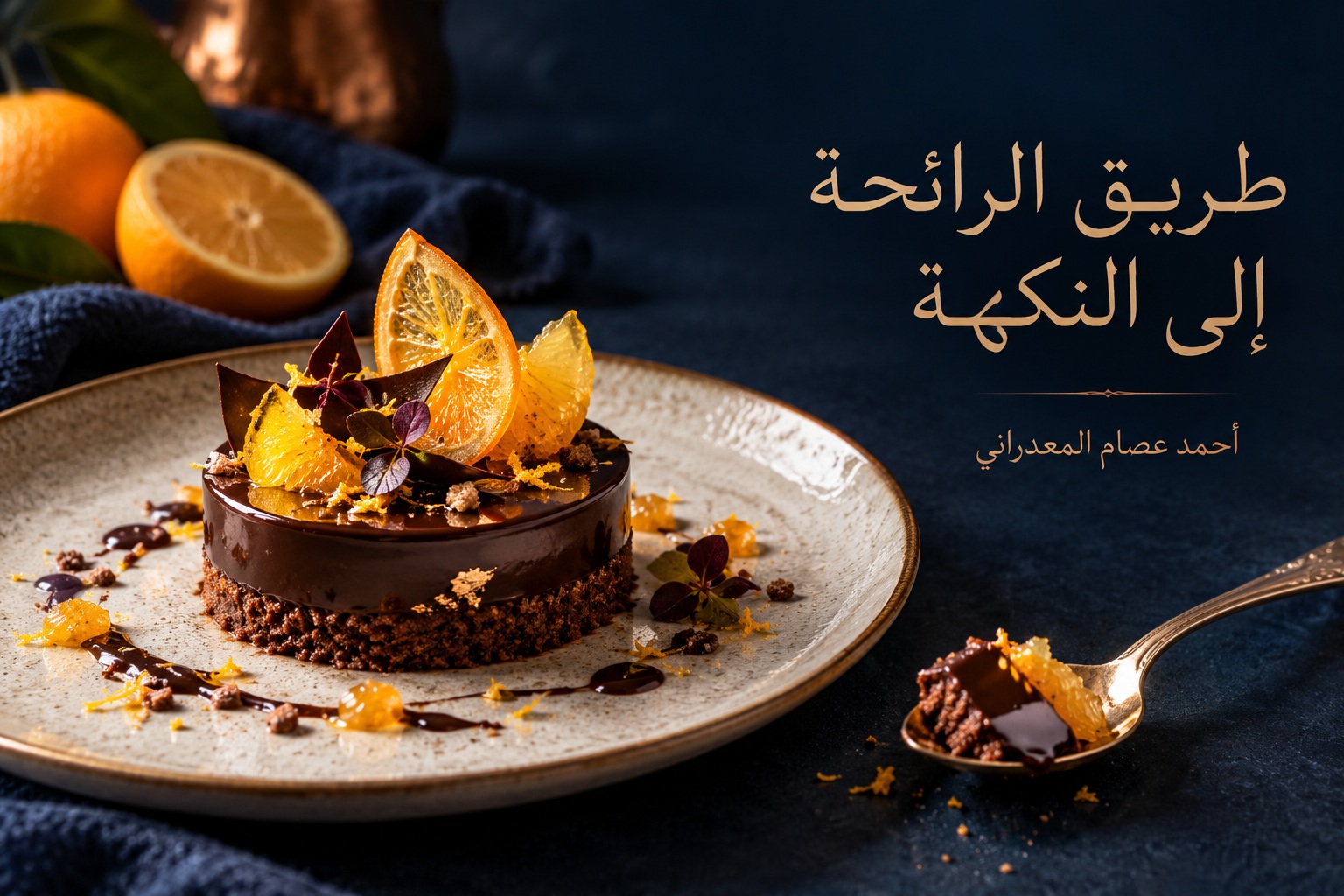
The Route from Aroma to Flavour: Why Smelling a Dish Differs from Eating It
Culinary Judgment and Taste Chemistry — Ahmad Issam Maadarani
Download article PDFBy Ahmad Issam Maadarani
This essay distinguishes orthonasal and retronasal odour delivery. It proposes two descriptive stages without treating either as a complete representation of the dish.
1. Two routes
Aromas can be smelled through the nose before eating, and volatile material can reach the nasal cavity from the mouth during eating. These are orthonasal and retronasal routes respectively. They do not create two separate foods; they make delivery route and observation stage part of the description. An aroma arising in the mouth should not automatically be renamed as a taste.
2. Limited human evidence
Small and colleagues investigated human neural responses to odours delivered by both routes [SMALL05]. Differences depended on route and odour, including an interaction for chocolate among tested stimuli. This does not establish identical route effects for every aroma or one route’s superiority for quality judgment. Imaged activity is not a food-preference scale.
3. Hypothetical example
A dessert smells clear above the plate but differs during eating. Matrix, texture, bite temperature and eating behaviour may contribute. Describe both stages rather than automatically declaring the second a failure. An opening aroma followed by transition may fulfil one purpose; a promise of persistent clarity may make the difference relevant to criticism.
4. Descriptive procedure
Specify pre-eating smelling time and duration, then gather observations during a suitable bite and afterwards. Record presentation, temperature and portion. Stages are not necessarily independent because smelling can create expectations. Studying those expectations needs a separate comparison rather than blending their influence with route description in a natural session.
5. Why not isolate everything?
Attempts to isolate smell can alter eating. This essay gives no instructions to prevent breathing or occlude the nose during consumption. Begin with structured natural descriptions before considering specialised research tools. Changing the task means studying a changed experience. Aroma strength alone cannot confirm ingredients or composition requiring independent verification.
6. Professional reading
Report pre-consumption aroma, during-consumption effects and their relation to purpose. This enables clearer discussion of aroma release and integration with taste. Research supports distinguishing routes, while the proposed description model needs training and judging evaluation. It does not replace integrated experience with nasal or neural measurement.
7. A Discussion Worksheet
| Field | Question | What to Record |
|---|---|---|
| Stage | Before or during eating? | Defined description timing and route. |
| Expectation | Did prior smelling influence the bite? | Limits to stage independence. |
| Function | Was the transition intended and successful? | A link to the declared purpose. |
Philosophical arguments belong to the author. Applications and worksheets are unvalidated proposals, and examples are hypothetical. This article presents no new experimental dataset, claim of worldwide priority or claim that this text has undergone peer review.
8. References and Source Limits
- [SMALL05]Small, D. M., et al. (2005). Differential neural responses evoked by orthonasal versus retronasal odorant perception in humans. Neuron, 47(4), 593–605. DOI: 10.1016/j.neuron.2005.07.022.Original research
Human functional imaging; some differences depend on route and odour identity. Source use: publication metadata and abstract; the full text was not reviewed for this edition.
Suggested citation: Maadarani, Ahmad Issam (2026). “The Route from Aroma to Flavour: Why Smelling a Dish Differs from Eating It”. Analytical essay, version 1.0, 4 October 2026.
© 2026 Ahmad Issam Maadarani.