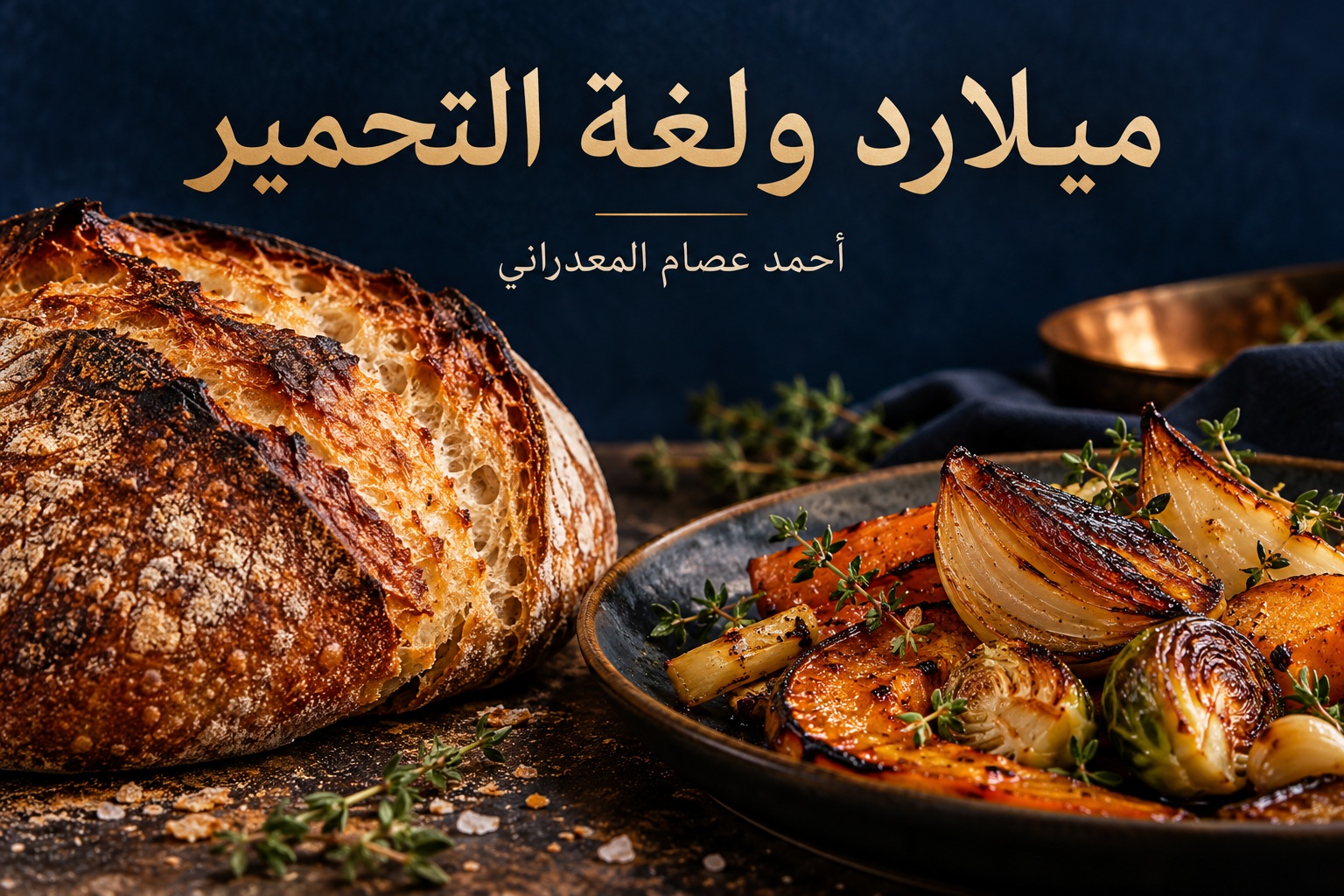
Maillard Chemistry and Browning: Why Colour Does Not Establish Aroma Identity or Cooking Quality
Culinary Judgment and Taste Chemistry — Ahmad Issam Maadarani
Download article PDFBy Ahmad Issam Maadarani
This essay examines limits to interpreting browning visually. It connects aroma-generating reactions with independent examination of aroma, texture and purpose, without reducing cooking to a brown surface or a chemical label.
1. A bounded chemical idea
Maillard chemistry includes reactions between amino compounds and reducing sugars, with subsequent pathways influenced by system conditions. Not every food-browning process is equivalent to it, and other processes may coexist. A brown surface alone does not justify naming the reaction or identifying an aromatic compound. Colour does not by itself reveal aroma composition.
2. Model-system evidence
Lee and colleagues analysed aroma-active compounds in model reactions between glutathione and reducing sugars [LEE10]. The work illustrates the need for aroma investigation beyond colour description. It does not represent every meat, bread or sauce, or transfer its compound list to any browned dish. Ingredients and conditions delimit the inference.
3. Hypothetical case
Two pieces share similar surface colour, but one offers appealing aroma and suitable texture while the other has dominating bitterness and dryness. That does not contradict the colour similarity. Appearance, aroma and texture require separate examination. Clarify whether “toasted” describes a particular aroma, taste, texture or merely visual character.
4. A small study
Define product, preparation conditions and measurement location. Document colour consistently if it is a target variable, then collect aroma, texture and taste descriptions. Surface photographs do not establish interior quality. Questions about particular compounds require suitable analysis and identity evidence, not sensory guessing. Separate preparation data from liking judgments.
5. Time is not a universal explanation
Longer heating does not generally improve quality. Desired and undesired relationships may change, and this essay gives no universal thermal recipe. Appearance does not establish cooking completeness or food safety; those questions require independent evidence. Sensory judging describes achievement, while scientific explanation specifies which process was actually measured.
6. Disciplined language
A report can describe strong visual browning with aroma insufficiently clear for the task without inventing a cause. The cook can then compare preparations to examine that cause. Maillard chemistry becomes a tool for questions and understanding rather than decorative explanation conferring value on every dark surface. The application needs real-product testing before adoption as a general criterion.
7. A Discussion Worksheet
| Field | Question | What to Record |
|---|---|---|
| Colour | Is it the measured variable? | An independent visual description. |
| Aroma | Which effect was perceived? | Clear vocabulary and stages. |
| Mechanism | Was the reaction pathway established? | Analysis or explicitly provisional attribution. |
Philosophical arguments belong to the author. Applications and worksheets are unvalidated proposals, and examples are hypothetical. This article presents no new experimental dataset, claim of worldwide priority or claim that this text has undergone peer review.
8. References and Source Limits
- [LEE10]Lee, S. M., Jo, Y. J., & Kim, Y. S. (2010). Investigation of the aroma-active compounds formed in the Maillard reaction between glutathione and reducing sugars. Journal of Agricultural and Food Chemistry, 58(5), 3116–3124. DOI: 10.1021/jf9043327.Original research
Model reactions and aroma-active compound analysis; not every browning process. Source use: publication metadata and abstract; the full text was not reviewed for this edition.
Suggested citation: Maadarani, Ahmad Issam (2026). “Maillard Chemistry and Browning: Why Colour Does Not Establish Aroma Identity or Cooking Quality”. Analytical essay, version 1.0, 4 October 2026.
© 2026 Ahmad Issam Maadarani.