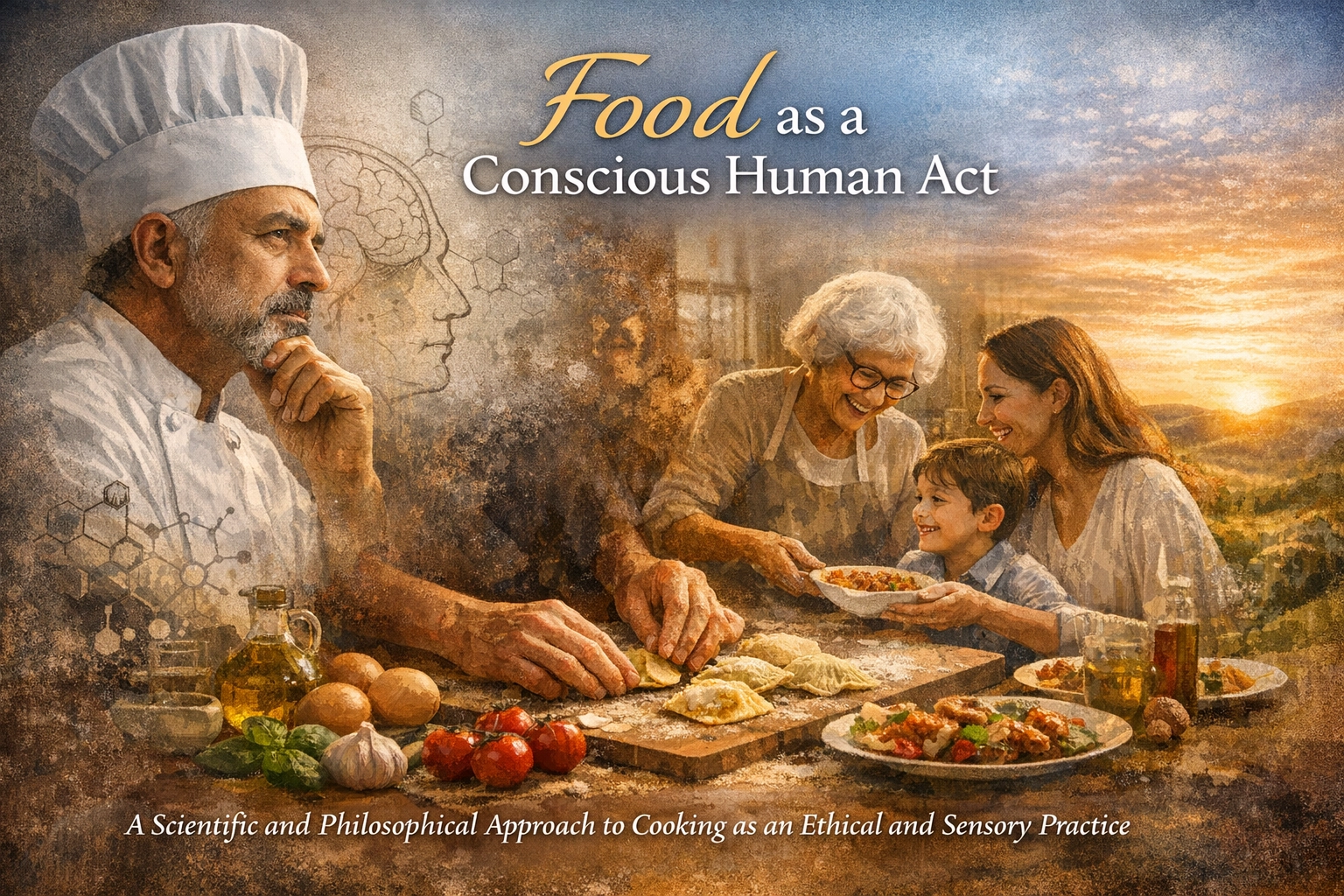
Food as a Conscious Human Act
A Scientific and Philosophical Approach to Cooking as an Ethical and Sensory Practice
Download article PDFFood has never been merely a response to hunger. Since the earliest stages of human existence, it has been a complex act where biology intersects with awareness, and where the body meets meaning. Humans did not begin cooking simply to improve taste, but to create stability, to reduce fear, and to establish control over time and nature. In this sense, cooking can be understood as one of the earliest unspoken philosophical acts, transforming food from a raw natural state into a conscious cultural practice.
From a scientific perspective, contemporary sensory neuroscience confirms that the human brain does not process food as a nutritional substance alone, but as a full multisensory experience. Brain regions associated with memory and emotion, such as the hippocampus and the amygdala, are strongly activated when food is linked to past experiences. This explains why a single aroma or flavor can evoke deep feelings of comfort, nostalgia, or loss. Such neurological responses demonstrate that food is not merely digested, but internally experienced, making cooking an act that directly shapes emotional and cognitive states.
Within this framework, culinary philosophy emerges not as an abstract discourse, but as a scientific and ethical necessity. The cook does not work with neutral material, but with a living human system influenced by psychological state, social context, and cognitive expectation. Research in behavioral nutrition has shown that a person’s perception of food prior to consumption can significantly alter physiological responses, including satiety, satisfaction, and even digestion. This indicates that honesty in cooking, mindful simplicity, and human respect are not poetic ideals, but biologically influential factors.
Culinary philosophy fundamentally rejects reducing food to calories, performance, or visual spectacle. It considers the dish a silent message and a relationship of trust between the one who prepares food and the one who receives it. When food is produced hastily, mechanically, or solely for display, it loses part of its internal impact, even if it appears technically perfect. This paradox defines the modern era: unprecedented food abundance accompanied by growing dissatisfaction, eating disorders, and a disconnection from the body’s natural signals.
Conscious cooking, from this perspective, is inseparable from respect for time. Time is not only a scientific factor governing biochemical transformations and flavor development, but also a philosophical stance reflecting patience, maturity, and resistance to forced shortcuts. Respecting time in cooking mirrors respecting time in knowledge: depth cannot be rushed without sacrificing meaning.
In matters of beauty, culinary philosophy distinguishes between functional beauty and deceptive aesthetics. While science confirms that visual presentation influences taste perception, it cannot compensate for imbalance or lack of authenticity. True beauty in cooking supports the entire sensory experience rather than momentarily deceiving the senses. A visually striking dish without internal harmony resembles an attractive idea without scientific foundation: briefly impressive, yet ultimately hollow.
Thus, the cook becomes a human witness rather than a technical executor. Every decision—from ingredient selection to preparation method and moment of service—represents both a cognitive and ethical position. Culinary philosophy does not require the cook to be a theoretical philosopher, but demands awareness of the profound impact of their actions on the human being before them, physically, psychologically, and emotionally.
When food is understood within this framework, it returns to its original meaning: an act of care rather than a consumable product. Culinary philosophy becomes a form of applied, silent science, integrating neuroscience, sensory psychology, and professional ethics without losing its human essence. In an increasingly noisy food world, this philosophy stands as a necessary reference point for restoring an honest and conscious relationship between humans and what they eat.
Written by:
Master Chef Ahmad Maadarani
President of the International Union of Arab Master Chefs
Researcher in Culinary Philosophy and Sensory Sciences