Umami: The Fifth Taste and the Structure of Depth in Professional Tasting
Umami Between Sensory Science and Professional Judging: From Neural Perception to Flavor Depth
Download article PDFIn modern sensory science, judging food is no longer based solely on the intensity of taste or the diversity of ingredients. Instead, it is increasingly linked to a dish’s ability to persuade the taster and provide a sense of completeness and satisfaction. This sensation is not always achieved through sweetness, saltiness, sourness, or bitterness, but is often realized through a deeper, calmer taste known as umami.
Umami is a taste that works at depth rather than asserting itself on the surface. It does not immediately attract attention upon tasting, but gradually emerges to give food cohesion and continuity. The presence of balanced umami makes a dish feel complete even if it is simple in its components, while its absence leaves flavors flat, no matter how complex or spice-rich the recipe may be.
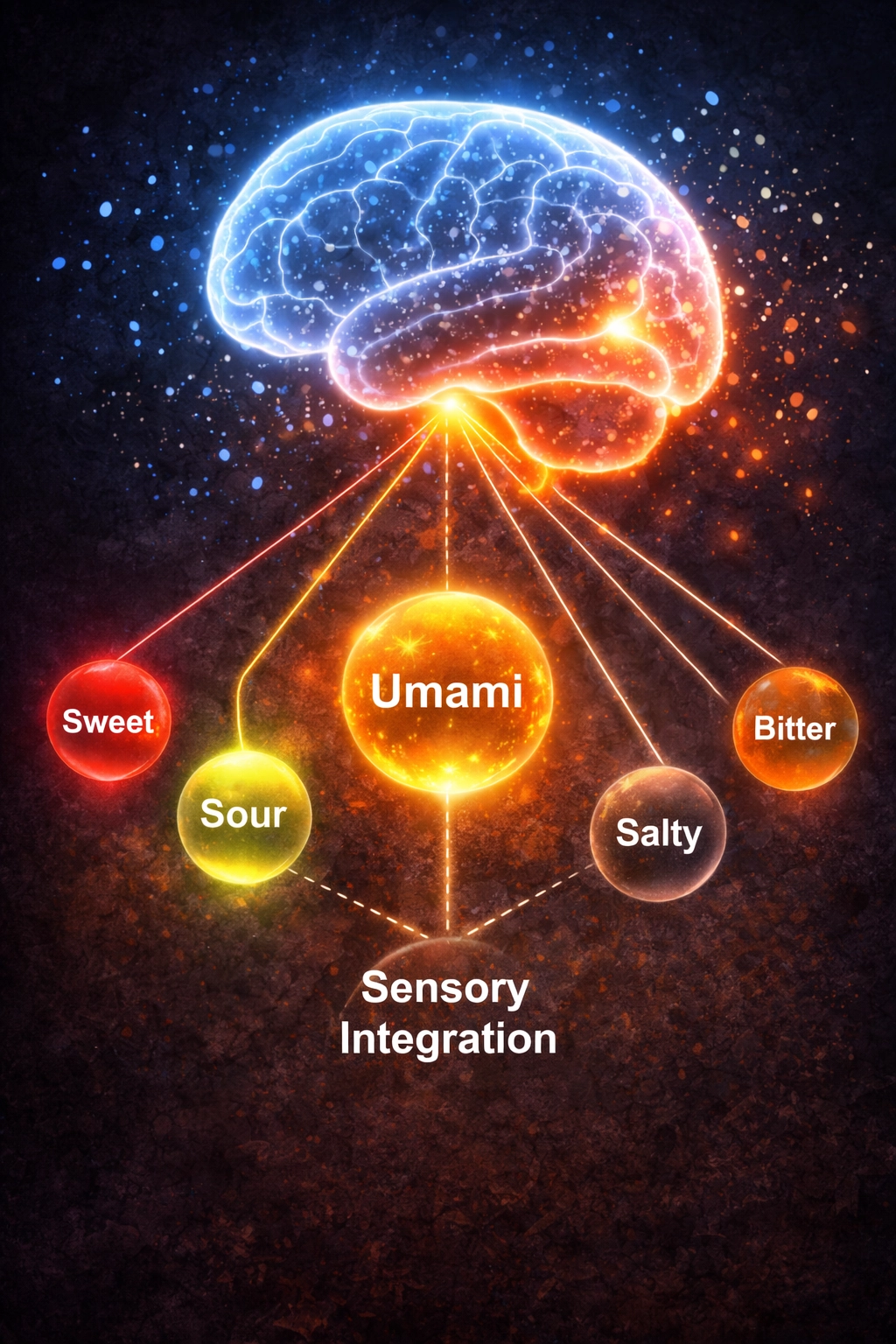
From a scientific perspective, umami is classified as one of the basic tastes recognized in sensory science. It is perceived through specialized taste receptors on the tongue that respond to specific natural compounds, most notably glutamates, inosinate, and guanylate. These compounds are not flavors in themselves; rather, they act as neural stimulants that lead the brain to interpret the sensory signal as a sensation of deep pleasure and fullness.

Glutamates occur naturally in many foods, and their concentration increases with ingredient ripeness, fermentation, or slow cooking. Inosinate is commonly associated with meats and fish, while guanylate is found in mushrooms and certain concentrated plant sources. When these compounds come together in a single dish, what is known as sensory synergy occurs, whereby the intensity of umami perception is amplified beyond the effect of each element alone.
Sensory-wise, umami is characterized by several distinct qualities, most notably a sense of mouth-filling fullness, smoothness of flavor, balanced spread, and persistence after swallowing. It is often accompanied by mild salivation that gives the mouth a feeling of comfort. Umami does not attack the tongue like saltiness, nor does it disappear quickly like sweetness; instead, it seeps in quietly and settles, making it a structural element in flavor construction.
One of the most common tasting errors is confusing umami with saltiness. Salt is a direct, sharp sensation, whereas umami is deep and structural. A dish can be rich in umami with low salt content, just as a very salty dish can be poor in umami. This distinction is fundamental to professional tasting and judging.
The importance of umami is particularly evident in a well-made stock. The quality of stock is not measured by its saltiness, but by its ability to fill the mouth and provide cohesion and depth. For this reason, hastily prepared stock, even if well-seasoned, rarely achieves true umami. Time is a decisive factor here, as slow cooking releases the compounds responsible for sensory depth.
Fish provides a classic example of natural umami, especially when grilled, dried, or smoked. The depth that distinguishes good fish flavor does not come from external seasoning, but from compounds within the fish flesh itself, which are revealed when proper cooking techniques are respected. As for good black coffee, although it is not a traditional source of umami, it is sometimes used as a training example to explain the difference between taste sharpness and depth of effect, where behind the bitterness there is a sense of body and persistence.
Time plays a central role in building umami. Slow cooking, fermentation, reduction, and aging are processes that do not add new flavors as much as they reveal latent flavors within ingredients. For this reason, umami stands as the opposite of shortcuts and fast cooking.
In plant-based cuisine, umami is used to compensate for the absence of meat through natural sources such as ripe cooked tomatoes, mushrooms, and slowly caramelized onions. This approach provides depth without artificiality and confirms that umami is not exclusive to animal ingredients.
In sensory judging, umami is not evaluated as an isolated element, but as part of the overall harmony of a dish. Its role in building depth, persistence, and service to the dish’s identity is considered without excess. Balanced umami elevates a dish’s quality, while excess is regarded as a clear judging flaw.
Philosophically, umami can be seen as an expression of respect for time and ingredients, and a rejection of shortcuts. It is a taste that does not shout, yet it remains, shaping the sensory memory of food. Dishes that possess true umami often carry a clear identity and give the taster a sense of honesty and completeness.
Accordingly, understanding umami is not a luxury of knowledge, but a necessity for every chef, judge, and researcher in sensory science. It is the backbone of flavor, the element that binds tastes together and grants food its true sensory value.
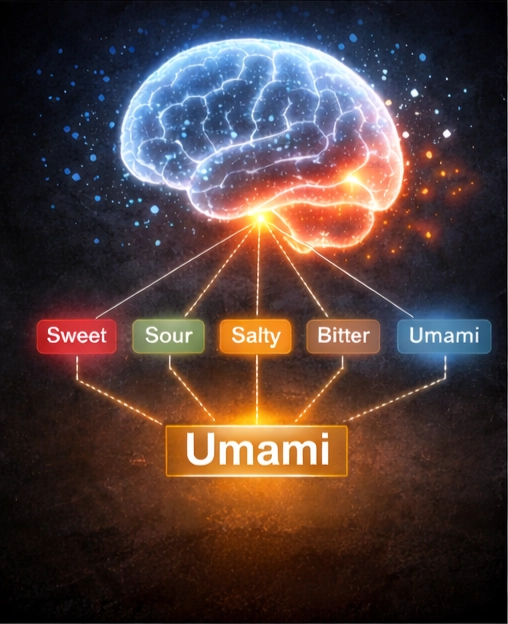
As understanding of umami deepens, it becomes clear that it does not function merely as a standalone taste, but as an internal regulatory mechanism for the entire sensory experience. Umami influences how other tastes are perceived and reorganizes their relationships within the mouth. In the presence of balanced umami, sweetness appears more mature and less superficial; acidity shifts from abrupt sharpness to refreshing brightness; bitterness integrates into the overall structure without conflict; and saltiness settles within a framework that does not overpower other elements. This regulatory role makes umami akin to a sensory backbone that gives the experience its harmony.
In advanced sensory science, umami is used as an indicator of sensory cohesion, meaning a dish’s ability to deliver a unified experience in which the taster does not perceive separation or conflict among tastes. Dishes lacking umami often feel fragmented, with each taste standing alone rather than forming a coherent whole. Balanced umami, by contrast, creates a sense of unity and stability.
Umami is also closely linked to the concept of delayed sensory satisfaction, the positive feeling that emerges after chewing and swallowing rather than during tasting alone. This type of satisfaction does not depend on intensity or surprise, but on depth, clarity, and persistence. For this reason, delayed satisfaction is one of the most important criteria used by professional judges when evaluating high-level dishes.
Judging experience shows that dishes achieving balanced delayed satisfaction are often rated as more professional, even if they are not the boldest or most complex. True sensory quality is not measured by shock value, but by the ability to leave a calm, stable positive impression in the taster’s memory. This explains why many simple classical dishes outperform complex modern ones that lack depth.
Educationally, umami serves as a key entry point for training chefs to build flavor consciously, away from overreliance on salt, fats, or quick enhancers. Understanding umami teaches chefs how to extract flavor from within the ingredient itself, respect its natural properties, and use time and technique instead of excessive additions. This awareness positively impacts both cooking quality and consumer health.
In recipe development, umami is used as a marker of a recipe’s maturity and stability. Recipes built on natural, well-considered umami sources are more reproducible and consistent in quality, whereas those relying on rapid escalation of spices or salt are prone to fluctuation and loss of identity. Thus, umami is viewed in professional practice as an indicator of mature culinary thinking.
Culturally, umami manifests differently across global cuisines while maintaining a single core essence of depth and fullness. Each culture employs its own tools and techniques—long stocks, fermentation, drying, or slow cooking—to build umami. This diversity confirms that umami is not a local or culture-bound concept, but a universal human experience that transcends geography.
Further analysis reveals that umami affects not only direct sensory perception, but also deeper neural mechanisms related to food choice decision-making. Applied sensory studies indicate that foods rich in balanced umami are unconsciously evaluated as more satisfying and higher in quality, even before tasting is complete. This rapid assessment is not based on intensity, but on neural signals linked to fullness and persistence, explaining humans’ instinctive attraction to foods with clear sensory depth.
Umami is also associated with sensory efficiency, a dish’s ability to deliver high satisfaction without excessive salt, fat, or sugar. From this perspective, umami is a powerful professional tool for developing healthy, balanced recipes, as it allows sodium reduction while maintaining palatability. This property has made umami central to modern nutrition programs and high-quality food product development.
In comparative judging, umami emerges as a decisive factor between a merely good dish and an expertly crafted one. When comparing dishes similar in technique and ingredients, sensory depth and persistence become the determining elements in final evaluation. Preference is often given to dishes that achieve clear umami balance without heaviness or excess, as they reflect the chef’s awareness and ability to control flavor rather than exaggerate it.
In professional competitions, dishes built on natural umami foundations show greater consistency in judges’ evaluations, while opinions diverge more widely on dishes relying on shock value or sharp escalation. This consistency is an important indicator of quality culinary design, as umami unifies sensory impressions and reduces subjective variation.
From an advanced educational perspective, umami is used to train tasters in sensory listening—the ability to observe how flavor evolves over time rather than judging it at first contact. This type of training develops patience and precision and is essential in preparing professional judges, whose assessments are based on the full experience from first taste to final aftereffect.
In building culinary identity, umami contributes to anchoring a dish’s personality and embedding it in memory. Flavors with true depth are more easily recalled, not because of their novelty, but because of their balance. For this reason, dishes rich in balanced umami are more likely to become signature dishes representing a chef or institution over time.
In this context, umami can be regarded as an ethical element in cooking, as it calls for honesty with ingredients and respect for their natural properties rather than masking or overpowering them. True umami is not imposed by force; it is extracted through knowledge and patience, reflecting a conscious culinary philosophy that sees food as a responsible human act rather than a mere consumer product.
Thus, umami completes its role as more than a fifth taste: it is a sensory framework, an evaluative tool, a way of thinking, and a bridge between science, practice, and philosophy. The greater a chef’s or judge’s awareness of this concept, the closer they come to the essence of professional tasting—rooted in depth rather than noise, and in lasting impact rather than shock.
Umami and Sensory Neuroscience
Recent research in sensory neuroscience shows that umami is not perceived solely through taste buds, but also contributes to activating neural networks associated with satisfaction, fullness, and food-related decision-making. When tasting food rich in balanced umami, neural signals suggesting adequacy and completeness are sent, reducing unconscious urges to continue eating or to intensify flavor with salt or fat. This neural interaction explains why certain foods feel “satisfying” even in moderate portions and why a balanced umami dish creates a sense of sufficiency.
Umami also contributes to stabilizing sensory perception over time. Rather than creating a fleeting shock, it builds a gradual sensation that accompanies the taster from the first bite through post-swallowing. This neural stability is one reason umami is considered essential in designing functional foods and balanced dietary systems, as it supports satisfaction without excess and fosters a healthier relationship with food.
Judging Case Studies (Applied Analysis)
In professional judging, the value of umami becomes clear when comparing dishes similar in technique and ingredients. In one judging case, two visually and conceptually similar dishes were presented: the first relied on heightened salt and spices to emphasize flavor, while the second was built on a slowly prepared stock and natural umami sources. Despite superficial similarity, the second dish received higher scores due to flavor depth, persistence, and delayed satisfaction, while the first was deemed sharp and sensorially fatiguing.
In another case, judging results showed greater consistency in evaluating a plant-based dish built on mushrooms and slowly cooked tomatoes compared to a meat dish relying on heavy sauces. This consistency among judges was considered an indicator of strong umami design, as it unified sensory perception and reduced subjective interpretation. These cases confirm that umami is not decorative, but a decisive criterion in professional and comparative evaluation.
Reference Conclusion
The above demonstrates that umami transcends its definition as a fifth taste to become a comprehensive sensory framework integrating science, technique, and philosophy. It is a builder of depth, an organizer of sensory experience, a precise judging criterion, and a bridge between palatability and healthy satisfaction. Conscious understanding and application of umami represent a shift from cooking driven by noise and escalation to cooking grounded in depth and continuity.
Accordingly, this article is adopted as a fixed reference for understanding umami in its scientific, professional, and judging contexts, affirming that refined cooking is not measured by what captures attention quickly, but by what leaves a lasting imprint in sensory memory—the true essence of umami.
Approved Scientific Reference
Maadarani, Ahmad.
Sensory Tasting Science and Flavor Evaluation in Culinary Arts.
Specialized scientific book, First Edition, 2019.
Reference Code: IUOAMC-MJ-REF-UMAMI-2019.
© All rights reserved to the electronic journal and the author.
Copying, quotation, or republication is prohibited without explicit reference to the author, the journal, and the reference code.